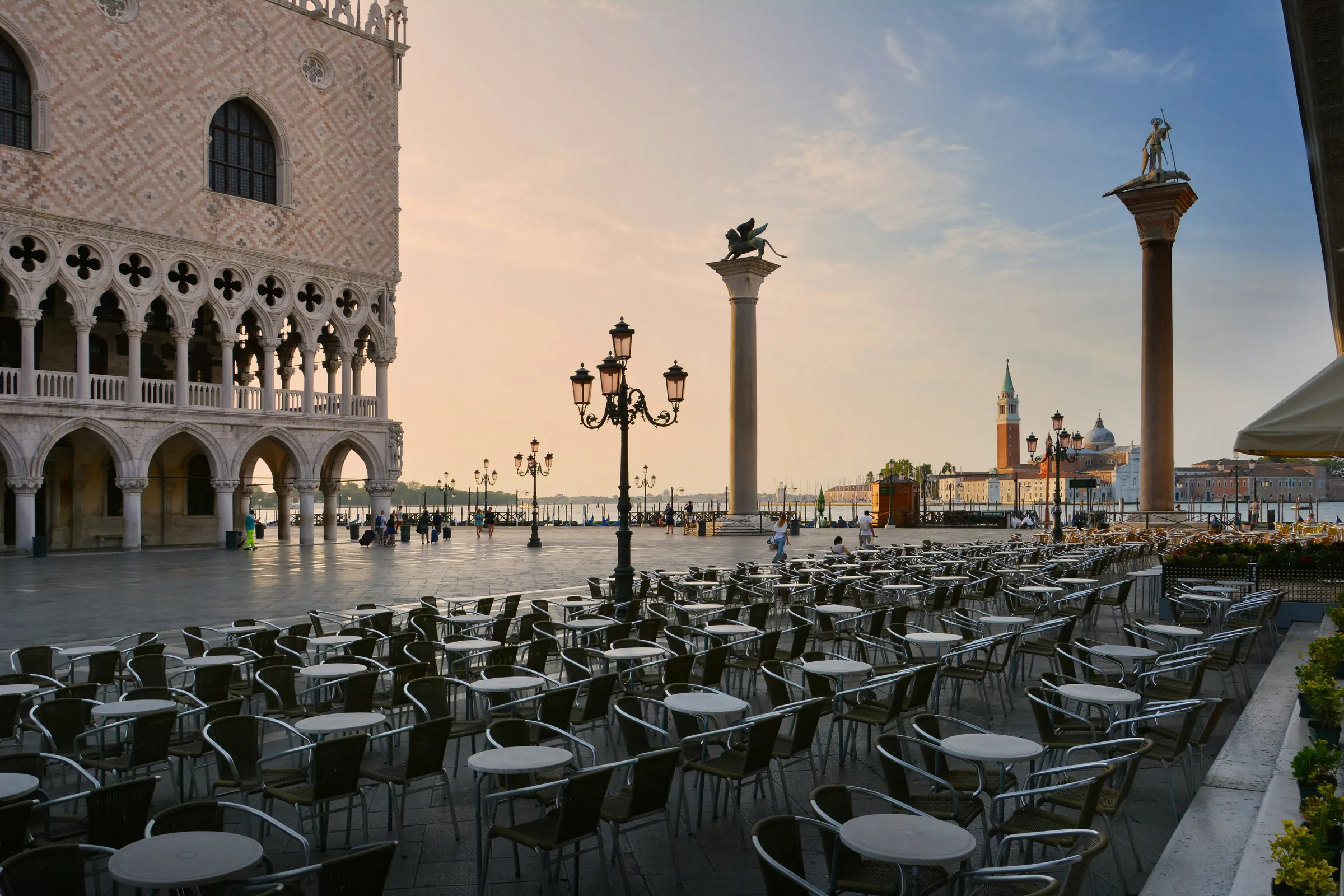
The shape of the facade
A building put up the wrong way round
Every instinct in stone architecture says heavy at the bottom, light at the top. The Doge's Palace does the opposite. Read its façade downward and you go from a solid acre of marble, through a row of slender columns, to an open arcade standing on the pavement. The weight is at the top and the holes are underneath — and it has stood like that for six hundred years.
-
Course · Top
The wall
A vast unbroken plane of pink Verona marble and white Istrian stone, set in a diamond lattice, pierced by only a handful of very large windows. Behind it are the biggest rooms in the building, including the Great Council chamber. This is where nearly all the weight is.
-
Course · Middle
The loggia
Seventy-one slender columns carrying pointed arches, and above them a continuous band of quatrefoil tracery — a running row of holes cut straight through the structural line. It is the most-copied piece of architecture in Venice and, structurally, the least likely.
-
Course · Ground
The arcade
Thirty-six short, thick columns standing directly on the pavement with no plinths, open to the Piazzetta and the waterfront on two sides. Over the centuries the ground has risen around them, so they look stubbier now than they were built to look.
↓ Course: Top → Middle → Ground
How the route runs
From the throne to the cells, one way only
The visitor route is not a loop, and that is deliberate: it follows the path a Venetian actually took through the machinery of the Republic. You climb through increasing splendour to the chamber where the state met, then cross a covered bridge over a canal, and come down the other side into the prisons. The bridge is the hinge of the whole building.
Venice empties and fills on the tide of the day-trip boats, and the palace follows it. The two windows worth aiming for are the first hour after opening, when the Great Council chamber is nearly empty and the light comes low across the lagoon into the loggia, and the last two hours of the afternoon, once the coach and cruise groups have gone back. The middle of the day between about eleven and three is the crush, and in July and August it is a serious one.
-
Side of the canal · Palace
The courtyard and the Giants' Staircase
You enter through the Porta della Carta into a Renaissance courtyard, at the head of which the Scala dei Giganti rises between colossal figures of Mars and Neptune — the two spheres, land and sea, that Venice claimed. Doges were crowned at the top of it.
-
Side of the canal · Palace
The Golden Staircase
The Scala d'Oro, vaulted in white stucco and 24-carat gold leaf. Built for ambassadors and dignitaries, it was designed to make the point about Venetian wealth before anyone had said a word.
-
Side of the canal · Palace
The Doge's Apartments
Surprisingly restrained private rooms. The doge was an elected head of state hedged about with restrictions, not a monarch, and he had to furnish these rooms at his own family's expense and vacate them within days of dying.
-
Side of the canal · Palace
The institutional chambers
The working rooms of the Republic — the Collegio, the Senate, the Council of Ten — each with a painted ceiling arguing, in allegory, that Venetian government was divinely endorsed. The Bocca di Leone, the lion's-mouth slot for anonymous denunciations, is on this route.
-
Side of the canal · Palace
The Great Council chamber
The climax: 53 metres long, no columns, and Tintoretto's Paradise filling the wall behind the throne. Around the top runs a frieze of the doges' portraits, with one painted out in black.
-
Side of the canal · The bridge
The Bridge of Sighs
An enclosed white limestone bridge, built around 1600, crossing the Rio di Palazzo. Two narrow stone-latticed windows. Everything before it is government; everything after it is imprisonment.
-
Side of the canal · Prison
The New Prisons
Stone corridors and cells across the canal, built when the older cells inside the palace proved inadequate. You walk back over the bridge to leave — the only part of the route you do twice.
The Doge's Palace at a glance
The room at the top of the climb
The Great Council chamber, and the doge who was erased
The Sala del Maggior Consiglio is one of the largest rooms in Europe built without a single supporting column, and behind the throne hangs what is generally reckoned the largest oil painting on canvas in the world. But the detail worth looking for is much smaller, and it is a hole in the decoration.
Tintoretto's Paradise fills the wall behind the throne in the Great Council chamber and is generally reckoned the largest oil painting on canvas anywhere. Around the top of the same room runs a frieze of portraits of the doges — except for one, Marin Falier, whose panel was painted out in black after his execution for conspiracy in 1355, with an inscription in the space where his face should be.
Doge's Palace opening hours
- April to October
- Daily 09:00–19:00, last admission 18:00
- November to March
- Daily 09:00–18:00, last admission 17:00
- Weekly closing day
- None — the palace opens every day
- Annual closures
- 25 December and 1 January
The palace occasionally extends its hours on selected evenings in high season and occasionally restricts access to individual rooms for restoration or state functions. Because your ticket is dated, check the museum's own calendar for your day if you are planning to arrive close to last admission.
Book your entry
Doge's Palace reserved entry tickets
Dated, reserved entry to the Doge's Palace, which also admits you to the three other St Mark's Square Museums — the Correr, the National Archaeological Museum and the Monumental Rooms of the Marciana Library. Booked through GetYourGuide, who list it as an official ticket.
See Doge's Palace tickets & times ↗- Four museums
- Reserved entry
Top-rated Venice experiences
In-depth Doge's Palace guides
The Doge's Palace audio guide and languages
Read more → Four museums, one day — and the three most people never useWhat your Doge's Palace ticket actually includes
Read more → Venice fills and empties on the tide of the day boats — plan around itWhen to visit the Doge's Palace
Read more → A one-way route, and the things worth stopping for on itWhat to see inside the Doge's Palace
Read more → The back rooms, the torture chamber and the cell Casanova escaped fromThe Secret Itineraries tour — is it worth it?
Read more → What a reserved ticket does and does not get you pastSkipping the queue at the Doge's Palace
Read more → Why Ruskin called it the central building of the worldUnderstanding the Doge's Palace façade
Read more → Two separate tickets, two separate queues, one small squareThe Doge's Palace and St Mark's Basilica in one day
Read more → A thousand years of a state that elected its head and did not trust himThe Republic that built the Doge's Palace
Read more → Practicalities: children, mobility, bags, food and the things that go wrongVisiting the Doge's Palace: practical notes
Read more →Good to know
Doge's Palace questions
What does the ticket include?
Reserved dated entry to the Doge's Palace, and admission to the three other St Mark's Square Museums: the Correr Museum, the National Archaeological Museum and the Monumental Rooms of the Marciana Library. The three sit together at the far end of Piazza San Marco from the palace and are entered through the Correr. The ticket is valid for one day.
Is this the same as the Venice Museum Pass?
No, and it is worth being clear about the difference. The Venice Museum Pass is a broader, more expensive ticket covering around a dozen civic museums across the city and islands, valid for six months. This is the St Mark's Square Museums ticket: the Doge's Palace plus the three museums in the square, valid for one day. If you are in Venice briefly and mainly want the palace, this is the right one.
Do I need to choose a time slot?
You book for a specific date, and the listing describes it as reserved entry — check the booking screen for your date, as the operator has been tightening entry management in recent seasons. Either way the practical benefit is the same: you go to the reserved-entry line rather than the ticket office queue, which in high season is the difference between walking in and standing on the Piazzetta for an hour.
How long should I allow?
Two to three hours for the palace itself. The route is long, it runs one way with limited opportunity to double back, and the rooms are dense with things worth stopping for. If you also intend to use the other three museums on the same ticket, allow the better part of a day, or plan to do them on a separate visit within the ticket's validity.
What is the Bridge of Sighs?
An enclosed limestone bridge built around 1600, crossing the narrow Rio di Palazzo to link the palace with the New Prisons. The name is a nineteenth-century romantic invention, popularised by Byron, imagining prisoners sighing at their last glimpse of Venice through its stone-latticed windows. The visitor route crosses it in both directions, so you will walk through it — though the famous photograph of the bridge is taken from outside, from the Ponte della Paglia on the waterfront.
Is Tintoretto's Paradise really the largest painting in the world?
It is very widely described as the largest oil painting on canvas in the world, at roughly 22 metres by 7. It fills the wall behind the doge's throne in the Great Council chamber and contains several hundred figures. Whether some larger canvas exists somewhere is the sort of question that depends on definitions, but the scale of the thing in the room is not in doubt.
Can I see the prisons and Casanova's cell?
The standard route takes you across the Bridge of Sighs into the New Prisons, and you walk the cell corridors there. The Piombi — the cells under the lead roof of the palace itself, from which Casanova famously escaped in 1756 — are not on the standard route; they are covered by the separate Secret Itineraries guided tour, which must be booked as its own ticket.
When is it quietest?
The first hour after opening at nine, and the last two hours of the afternoon. Venice's day-visitor numbers peak between roughly eleven and three, and the palace fills accordingly. Winter weekdays are dramatically calmer than anything between May and September, and if you have any choice in the matter, a November morning is a completely different experience from an August lunchtime.
How do I get there?
The palace stands on the Piazzetta, the open space between St Mark's Square and the lagoon. Venice has no cars, so you arrive on foot or by water. The nearest vaporetto stops are San Zaccaria and San Marco–Vallaresso, both a few minutes' walk. From the railway station or Piazzale Roma, Line 1 or Line 2 runs down the Grand Canal to St Mark's.
Is it accessible?
Much of the main route is reachable by lift and the museum publishes an accessible itinerary, but some historic sections — the Bridge of Sighs and the prison corridors in particular — involve steps and narrow passages that cannot be adapted. If you have specific access needs, check the museum's own current accessibility information for your date before booking, since the arrangements change with restoration work.